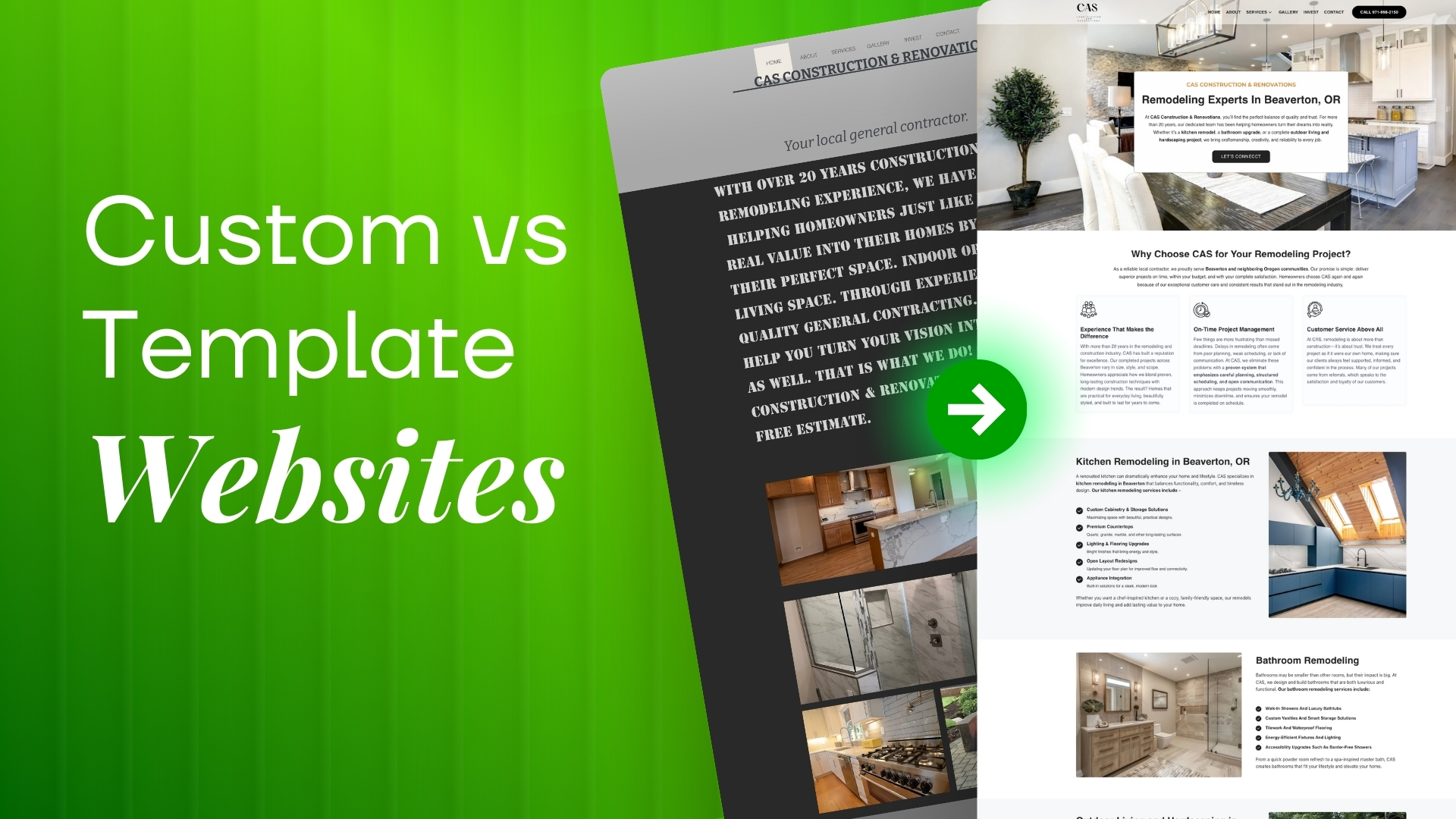
Custom Vs. Template Website Design: Making The Right Choice
A template website delivers the best results for businesses that need a fast UI/UX, affordability, and an easy-to-use CMS with minimal setup. However, a custom-designed website is the better and more effective option for businesses that have to prioritize their own brand uniqueness, long-term growth, strong SEO practices, and need full control over website performance and backend features. In simple terms, templates help you get online quickly with minimal maintenance. But custom design helps you transform your whole site as market trends shift and major updates to the overall design & structure become mandatory to remain competitive over time.
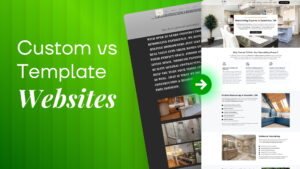
In this guide, we break down the real differences below so that, as a business owner, you can decide which options fit your budget, timeline, and future business goals.
What is custom website design?
A custom website design is all about creating a website based on a business’s target audience. Designers first research real customers, then create a unique site, wireframes, and prototypes. Visual designs are carefully created using professional tools such as Figma or Adobe XD before developers build the structures using custom code.
Developers have full control over design and features and can add new functionality as audience needs and perspectives evolve over the year. For a custom-coded structure, it loads faster, and the UI/UX responds smoothly, with best SEO practices as needed, to build trust, authority, and online visibility.
What is a template website?
A pre-designed layout is often known as a template website. It’s a framework rather than a work of unique imagination. In a template site, you can simply replace all text, images, and logos with your own content.
Most templates include Home, About, Contact pages, basic e-commerce tools, and basic features such as forms and image galleries. No coding is required, and everything can be managed with a drag-and-drop CMS like WordPress, Squarespace, or Wix.
Top 12 Key Differences Between Custom Design and Template Website 2026
In 2026, the differences between custom-designed and template websites are evaluated based on budget, design freedom, website speed, ability to grow, and long-term usability. Templates are a more cost-effective option for businesses, while custom designs offer better SEO, stronger branding, and greater backend flexibility. But along with this, here are more differences below that would be better to consider before deciding:
1. Cost & Budget Comparison
Template websites typically cost $0–$2,700 and are an ideal option for small-budget businesses. But you will have to pay a lot, around almost $4,000–$15,000+ to create a custom design site if you want strategy, custom coding, and goal-tailored features.
2. Design Flexibility & Customization
You have 100% design freedom with custom websites, as they are built with your brand imagery in mind. But templates limit customization to re-add new layouts. That’s why more than 70% of small to large brands prefer to build their site via custom layouts to appear professional.
3. Development Time & Speed to Launch
Templates can launch in hours, and sometimes it might take 1–4 weeks. But custom websites take 6–12+ weeks due to deep audience research, design, and pre-launch testing. Templates are faster to launch, but custom design offers long-term stability.
4. Scalability & Long-Term Growth
Custom websites are built to scale traffic growth, new features, and expansions. Templates often struggle as businesses grow. Studies show that 60% of template sites require major rebuilding after 2–3 years.
5. SEO Performance & AI Search Visibility
Custom websites are built with clean code, improving all areas of Core Web Vitals and helping both Google and AI search engines to crawl your site content faster. Templates rely on plugins, so SEO results from proper implementation may take time to appear. Remember, custom-built sites have a higher chance of getting 20–40% more organic and AI visibility.
6. Website Speed & Super Fast UI/UX Responses
A custom website is like a freshly packed backpack with the necessary items (front-end & backend features) inside, so it’s lightweight. A template website is like a pre-packed suitcase with lots of extra items (plugins) that you don’t need, and it makes the suitcase slower to move.
7. Satisfying User Experience & Customer Grabbing Layouts
Custom design allows layouts based on real user psychology. Where template websites are randomly built on generic design ideas. A custom website is like designing a layout exactly the way people expect to make a decision. But templates are made of standard layouts used across sites.
8. Reliable Security & Ongoing Maintenance
Custom websites offer stronger security because features are uniquely designed. Templates are common targets due to shared plugins. In 2026, more than 40% of WordPress security issues are caused by third-party plugin access.
9. Ownership, Control & Platform Dependency
With a custom design, you own the code and can switch your current developers at any time. Templates often lock you into platforms like Wix or Squarespace. This platform dependency often limits the flexibility to think freely and increases extra costs to reupdate any major features.
10. Website’s Ability to Support AI & New Technologies
Developers can easily integrate AI tools into custom website features such as chatbots, automation, and advanced analytics. But templates might restrict necessary technology integrations. That’s why, in 2026, modern businesses choose custom frameworks to keep up with AI-driven search trends.
11. AI & Personalization
Custom websites support advanced personalization by showing your visitors dynamic content, quick QA through ChatBot, and giving behavior-based experiences. But in such a situation, templates only offer basic personalization, which is ineffective in 2026. In 2026, personalized websites increase conversions by 10–25% for service and eCommerce-based businesses.
12. Upfront vs. Long-term Cost
Templates cost less upfront but often require redesigns, upgrades, or migrations within a year. Custom websites cost more initially but reduce future rebuild costs. Over 5 years, custom sites often deliver higher ROI despite higher starting prices.
Advantages and Disadvantages of Custom Design
Custom website design has significant advantages like stronger personal branding, full flexibility in updates, and better long-term performance. But you should also remember that it also requires higher upfront costs and more time to build. Here’s a detailed look at the advantages and disadvantages of custom design:
Advantages:
- Good for Personal Branding: A custom website lets your colors, fonts, and layout represent who you are, rather than copying others’ strategy.
- Tailored User Experience (UX): Because the site is built for your audience, it naturally captures visitors’ attention and encourages actions.
- Enhanced SEO Performance: Custom websites use only code, which helps pages load faster and makes it easier for Google to crawl and rank higher.
- Flexibility and Scalability: As your business grows, a custom site can be easily adapted to add new features and tools.
- Increased Security: Since the code is personally created and not shared with thousands of other sites, it becomes harder to hack.
- Full Ownership and Control: With a custom design, you have full control over your website and can expand it anytime.
Disadvantages:
- Higher Upfront Costs: A custom website costs more upfront, and the reason is that developers must plan, design, and execute it uniquely.
- Longer Development Time: Because no pages or layouts are pre-made, a custom site typically takes longer to complete.
- Requires Professional Maintenance: Custom websites typically require a developer to add updates and resolve any backend technical issues.
- Higher Effort for Simple Needs: If you only need a basic website with a few pages, a custom design may feel like overkill.
Advantages and Disadvantages of Template Websites
Template websites are a good choice when you are on a tight budget, but they may look the same as other competitors. Also, they will not load within 1-3 sec as a custom site does, and it’s not possible to add new features. Here’s a detailed look at the advantages and disadvantages of template websites:
Advantages:
- Cheaper Price: Template comes in budget-friendly cost because you don’t need to build everything from scratch.
- Quick Launch: With minimal setup, you can have your website online within a day.
- No Technical Expertise Needed: Template’s CMS has easy drag-and-drop tools, where you can update content, and no code is needed.
- Built-in Basic Practices: Templates are designed with a basic layout and mobile-friendly structure, ensuring your site looks good on all devices.
Disadvantages:
- Lack of Uniqueness: Your website might look the same as your competitors’, which doesn’t add any uniqueness.
- Code Bloat and Slower Speeds: Templates run on all plugins that differents pugins weight, making the site load slowly.
- Limited Customization: Small changes are possible in Templates but when you need a change to the deep structure, you might have to face limitations.
- Scalability Roadblocks: When your business reaches the top level, you need advanced features to add, but unfortunately, templates often can’t keep up.
- Security Risks: Because popular templates are used by thousands of sites, hackers find the weak points easily to hack your business site.
Custom Website vs Template Website: Which One Is Better for Your Business in 2026?
The decision completely depends on your current business condition, level, how much you can spend, and where you want to take your brands. Established brands often prioritize custom websites because they must focus on speed, results, and long-term returns, while templates are a starting point for small business owners who need to go live quickly.
Why Choose a Custom Website in 2026?
- Performance & Core Web Vitals: When you want Google to love your fast-loading sites, as they can crawl and explore all your site content to recognise it as valuable. Custom websites are built with clean, lean code, with no extra clutter, so Google and AI engines find them easier to read and index.
- Higher Conversion Rates: When you want to design every layout of your website based on how your customers think and act in mind. So, for a unique design, visitors are naturally guided to buy or sign up.
- Advanced Integrations: When your site needs to integrate with CRM, booking tools, or inventory systems, with the help of agencies like We Misc.
- AI Personalization: When AI automation becomes mandatory to answer quick answers to engage your audience before you step in.
Why Choose a Template Website in 2026?
- Immediate Visibility: If you need a website online quickly to market your short-term service offering, event, or new service, choose templates.
- Low Barrier to Entry: Templates offer a professional digital interface and are an ideal option if you don’t want to spend heavily upfront.
- AI-Enhanced Building: In 2026, modern templates assist users in designing layouts and content, but still require final manual adjustments. If you can keep it as it is, then choose templates.
“Quick Decision Guide: When your business depends on long-term growth, brand authority, SEO performance, and conversions, then a custom website would be your smart investment. But if your goal is to just launch fast, test new business ideas, or stay within a tight budget, a template website would be your logical investment.”
Complete Comparison Table: Custom Design vs Template Website
In 2026, the value gap between custom and template websites largely reflects the amount of research, time, and planning required to build a unique UI/UX, develop strategic conversion layouts, create trust-building visuals, and make an eCom site a conversion machine. Templates are a cheaper option, and custom websites cost more, but honestly, in 2026, a custom design helps your business to appear different.
So, custom designs are mandatory for businesses that need unique branding, next-level performance, and deeper scalability. Below is a detailed, side-by-side comparison to help you decide between custom design and template websites:
| Feature | Custom Design | Template Websites |
| Cost | High initial investment | Low initial, lower cost |
| Development Time | 8–20+ weeks | Days to 2 weeks |
| Uniqueness | Fully custom, one-of-a-kind | Pre-made, looks like many others |
| Scalability | High | Limited |
| SEO & Performance | Clean code, fast, optimized | Can be bloated, slower |
| Maintenance | Needs professional support | DIY updates, platform tools |
| Flexibility | Unlimited features | Restricted by theme structure |
| AI & Future Readiness | Supports AI tools | Limited AI features |
| Conversion & UX | Optimized for sales & sign-ups | Generic layouts, less control |
| Ownership & Control | Full code, hosting, and update control | limited control |
| E-commerce Support | Fully customized shopping features | Basic store setup |
| Security | Robust protection | Standard |
| Content Structure | Optimized for search engines | less flexible for SEO |
| Analytics & Tracking | Custom setup for deep insights | Basic analytics integration |
| Customization for Local SEO | Easy to target specific locations | Limited by theme |
Final Words
At We Misc, we have been designing custom websites for 8+ years and have successfully launched over 800 custom-coded websites for our reputable businesses worldwide.
So, like them, if you want to build a successful custom-made online interface. We, Misc, are here to help you reach that level by clearly defining your values to your target audience and building a unique custom design to become a trusted brand among them.
Get your Free Quote Today. Let’s build a custom digital experience together for your business.
Frequently Asked Questions
Which Website Type Is Better for Conversion-Focused Design?
Custom websites are more conversion-focused because they guide users through tailored sales funnels, CTA placements, and unique layouts that boost conversions.
Is a Template Website Enough for Competitive Niches?
Not always. In highly competitive niches, standing out with speed, unique branding, and unique personalized features is key that templates often struggle to deliver.
Which Option Delivers Better Return on Investment (ROI)?
Custom websites typically deliver higher long-term ROI due to better performance, SEO, scalability, and conversion rates. Templates save money upfront but may cost more later due to limitations on feature integration.
Is a Template Website Too Cheap to Be Effective?
No, templates can be effective for simple businesses, but they may lack advanced functionality, scalability, and brand uniqueness that will not grow with your business.
Does Higher Cost Actually Mean Better Results?
Not automatically. Higher costs help when they support strategic design, coding quality, SEO, and custom features—these factors drive better results.
Which Website Design Type Offers the Best Value Over 1–3 Years?
Custom websites often deliver better long-term value because they scale with your business, maintain SEO and performance, and require fewer redesigns than templates.
Do Template Websites Hurt SEO, AEO, and GEO?
Not necessarily, but templates can include “bloat” code, slower speed, and less optimized structure, which may reduce SEO and AI search visibility compared to a well-coded custom site.
Does a Custom Website Make My Business Look More Professional?
Yes. Custom design uniquely reflects your brand identity, builds trust, and positions your business as credible and high-quality.
Which Website design type is best for Mobile Experience?
Custom websites deliver fully responsive, optimized mobile experiences, while templates may adapt automatically but can still have layout issues or slower mobile load times.